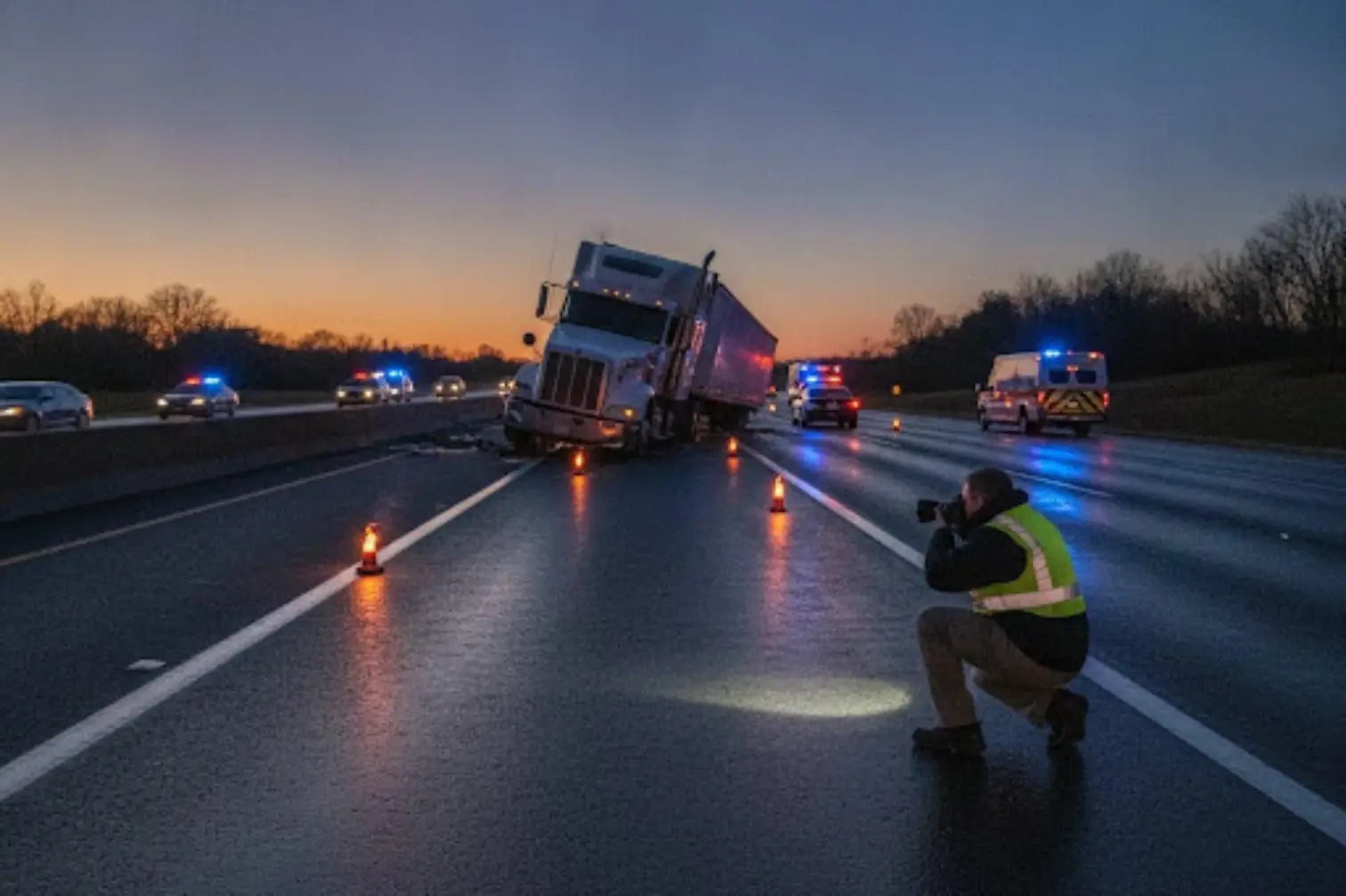

When an eighty-thousand-pound tractor-trailer collides with a standard passenger car, the physical destruction is catastrophic. Heavy freight corridors across Richmond carry thousands of commercial rigs daily. Navigating the aftermath demands immediate precision, as commercial motor carriers move quickly to protect their own interests. The seasoned Richmond truck accident lawyers at Tronfeld West & Durrett fight to protect victims injured on these dangerous roadways. Understanding what actions to take following a wreck in Central Virginia can mean the difference between recovering substantial compensation and being left to pay medical bills out of pocket.
Secure the Crash Scene and Call Emergency Services
Personal safety takes precedence over everything else. If the collision occurred on high-speed roadways like Interstate 95 near the James River Bridge, Interstate 64, or the Powhite Parkway, secondary crashes present a serious threat. Moving vehicles out of the travel lanes to the nearest shoulder prevents chain-reaction impacts. When vehicles cannot move, drivers and passengers should turn on hazard flashers, exit the vehicle if it is safe to do so, and move behind concrete barriers or up the embankment.
Dial 911 right away. Dispatchers will deploy emergency personnel along with the appropriate law enforcement agency. The Richmond Police Department handles wrecks on local city streets such as Broad Street, Midlothian Turnpike, or Commerce Road. Collisions on regional expressways fall under the jurisdiction of the Virginia State Police. Inform dispatchers that a commercial vehicle is involved so that they can dispatch the proper medical units and hazardous material response teams if diesel fuel or freight has spilled.
For answers to your questions, call: 800-321-6741
Obtain Urgent Medical Care in Central Virginia
The sheer impact force of heavy commercial vehicles produces extreme trauma. Even when you believe your injuries are manageable, an immediate clinical evaluation is mandatory. Sudden surges of adrenaline routinely mask symptoms of life-threatening internal bleeding, organ damage, or whiplash.
Serious collisions frequently lead to traumatic brain injuries or acute spinal cord trauma. Richmond is home to premier trauma facilities, including VCU Medical Center, which operates the only comprehensive Level 1 trauma center in the region. Patients may also receive urgent stabilization at Bon Secours St. Mary’s Hospital or Henrico Doctors’ Hospital. Seeking same-day medical treatment establishes a direct medical record linking bodily harm to the crash. Gaps in medical care provide corporate defense attorneys with opportunities to argue that your injuries originated elsewhere.
Collect Physical Evidence from the Truck and Accident Scene
Commercial trucking companies dispatch corporate investigators and crash reconstructionists to catastrophic accident sites within hours. Drivers should collect objective evidence before debris is removed, highway lanes reopen, and vehicle positions shift.
- Record the truck driver’s name, commercial driver’s license number, phone contact, and address.
- Locate the motor carrier identification numbers displayed on the cab door. Note the United States Department of Transportation number and the Motor Carrier docket number. The tractor and the trailer are often owned by two entirely separate corporate entities.
- Take extensive photographs and videos of the damage to all vehicles from several distances. Capture roadway gouges, tire skid marks, fluid trails, debris fields, broken guardrails, and cargo spills.
- Document environmental factors, including wet pavement, reduced visibility, construction signage, and traffic signals.
- Collect contact information from eyewitnesses, commuters, or nearby shop workers who saw the impact. Neutral testimony carries enormous weight during settlement negotiations and trial.
Click to contact us today
Protect Yourself Against Virginia Contributory Negligence
Virginia operates under one of the strictest negligence standards in the United States. Under the doctrine of pure contributory negligence, an injured motorist who contributed even one percent of fault to a collision is legally barred from collecting any financial compensation from the other driver. A negligent trucker can be ninety-nine percent at fault, yet the injured party receives zero damages if the defense proves the motorist made a slight driving error.
Because of this ruthless defense threshold, understanding contributory negligence in Virginia is essential for every driver. At the scene, speak only about factual observations to investigating police officers. Never apologize. Do not use conversational courtesies like saying you did not see the truck coming or that you could have braked sooner. Commercial insurers train adjusters to elicit innocent comments and twist them into admissions of fault.
When insurance representatives contact you in the days following the crash, do not provide a recorded statement. Adjusters frequently sound sympathetic while phrasing questions designed to trap you into accepting partial blame. Never consent to providing a recorded statement during an insurance claim before speaking with an attorney.
Complete a Free Case Evaluation form now
Secure the Official Virginia Police Crash Report
Virginia law requires an official report whenever a vehicle collision causes injury, death, or property damage exceeding fifteen hundred dollars. Responding law enforcement officers compile this information on Form FR300, creating an initial official record of the event.
Request the investigating officer’s badge number, name, and incident tracking number before leaving the area. Within several days of the crash, you can arrange for obtaining an official accident report in Virginia through the Virginia Department of Motor Vehicles. Examine the document closely to ensure that the investigating officer recorded the correct motor carrier names, insurance policies, and highway positions. Errors in the initial police report must be addressed quickly through formal legal correspondence.
Issue an Immediate Spoliation of Evidence Notice
Standard car wrecks rely primarily on police reports and vehicle damage photos. Commercial truck accidents are far more complex, requiring extensive digital, mechanical, and regulatory documentation. Motor carriers maintain extensive data systems governed by Federal Motor Carrier Safety Administration regulations.
Federal regulations permit trucking companies to overwrite or discard certain operational logs after thirty to ninety days unless formal legal action demands their preservation. Experienced attorneys send an immediate spoliation letter to the carrier, their corporate parent, and their insurance underwriters. This legal demand requires the company to preserve vital evidence, including:
- Electronic logging device records showing driving hours, off-duty time, and rest breaks.
- Engine control module and event data recorder telemetry tracking travel speed, throttle position, and brake application right before the crash.
- In-cab video footage from forward-facing and driver-monitoring dashboard cameras.
- Driver qualification files, including commercial driver licensing verification, medical examiner certifications, background checks, and past driving violations.
- Post-crash toxicology screenings for controlled substances and alcohol.
- Fleet maintenance records, tire inspection logs, and brake component adjustment sheets.
- Cargo manifests, weigh station receipts, and bills of lading verifying freight distribution.
Proving that a carrier violated safety protocols can alter the outcome of a case, as documented regulatory violations strengthen truck injury claims against reckless logistics operations.
Identify Every Liable Corporate Entity
Commercial freight involves a web of corporate entities contracted to move goods between shipping hubs, rail yards, and retail warehouses. Identifying every responsible business entity expands the available insurance coverage needed to satisfy catastrophic injury claims. Complex 18-wheeler collisions regularly involve multiple defendants:
The truck driver can be held accountable for speeding, texting, tailgating, or falling asleep behind the wheel. The motor carrier faces liability for vicarious actions, negligent hiring, poor safety oversight, or enforcing delivery schedules that force drivers to violate federal hours-of-service mandates. Third-party maintenance contractors bear responsibility when faulty brake replacements or deferred tire maintenance lead to mechanical breakdowns. Freight loaders and distribution warehouses face legal claims if improperly balanced cargo shifts, triggering trailer jackknifes or rollovers.
Uncovering these contractual relationships requires a thorough legal review of freight agreements, shipping manifests, and broker-carrier contracts. Thoroughly analyzing liability and fault in Virginia truck accidents ensures that no negligent corporation escapes accountability.
Document Financial Losses and Ongoing Physical Limitations
Recovering complete financial compensation requires comprehensive proof of every economic and non-economic harm you have suffered. Establish an organized record system from the very beginning of your recovery process:
Retain every medical invoice, diagnostic bill, physical therapy statement, and pharmacy receipt. Request formal documentation from your employer outlining missed work shifts, lost hourly compensation, used vacation days, and projected earnings reductions. Keep a daily journal tracking your physical pain, sleep disruption, emotional stress, and daily activities you can no longer handle unassisted. High-exposure commercial vehicle crashes demand clear evidence showing how injuries alter your long-term quality of life.
Monitor the Strict Virginia Statute of Limitations
Injured individuals face rigid deadlines to initiate legal action in Virginia courts. Under Virginia Code Section 8.01-243, a person injured in a motor vehicle collision generally has two years from the crash date to file a personal injury lawsuit. Wrongful death actions resulting from fatal truck crashes also carry a two-year filing period, running from the date of the family member’s passing.
Courts apply this deadline strictly. Missing the deadline means the civil court will dismiss your lawsuit with prejudice, permanently destroying your ability to collect financial recovery. Special rules apply when commercial vehicles are owned or operated by municipal governments or state agencies, often requiring formal written notice within six months. Reviewing the applicable statute of limitations for personal injury claims in Virginia with counsel ensures your rights remain fully protected.
Consult a Proven Richmond Truck Accident Law Firm
Tractor-trailer claims are not ordinary auto accident cases. Commercial carriers carry multi-million-dollar insurance policies and employ teams of defense lawyers trained to defeat claims before they reach court. Trying to negotiate alone against sophisticated adjusters while healing from severe physical injuries puts you at a massive disadvantage.
Tronfeld West & Durrett has stood up for injured Virginians for over fifty years. Our legal team understands how commercial defense firms operate in Central Virginia courts, whether filing claims in the Richmond Circuit Court at the John Marshall Courts Building or pursuing corporate entities in the United States District Court for the Eastern District of Virginia. We dispatch skilled investigators, secure critical black box data before it disappears, and build thorough cases capable of overcoming Virginia contributory negligence arguments.
When a commercial vehicle collision turns your life upside down in Richmond, taking the right steps immediately protects your physical well-being and your legal future. Reach out to Tronfeld West & Durrett to discuss your collision, evaluate liability, and demand the full financial recovery you need to rebuild your life.
Call or text 800-321-6741 or complete a Free Case Evaluation form