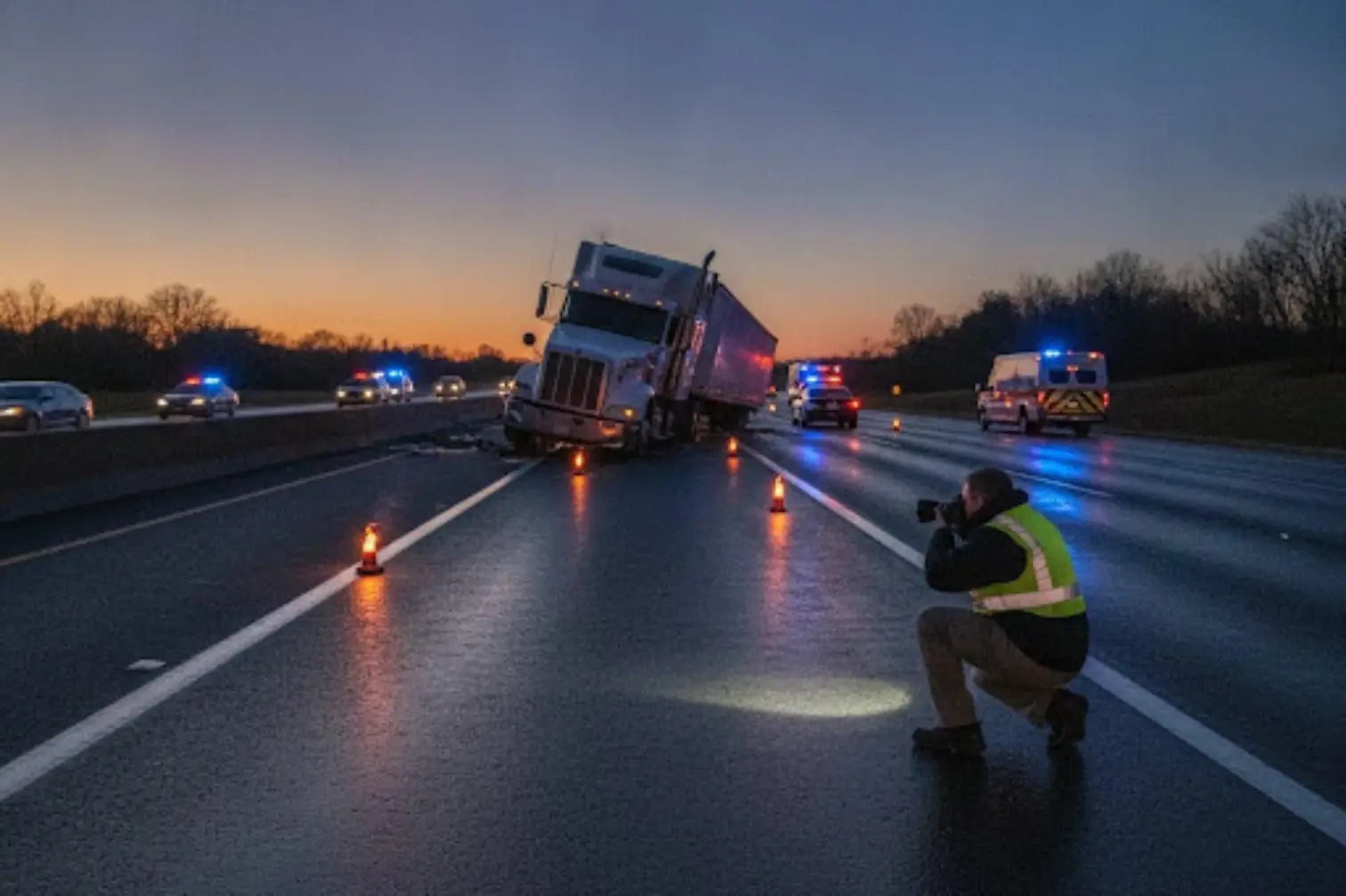

Truck crashes fall into recognizable patterns, and the pattern usually tells you where the fault is going to be found. A jackknife points at braking and load distribution. A blowout points at inspection records. An underride points at trailer equipment. Knowing which category a collision belongs to is how an investigation gets pointed in the right direction quickly. Our Virginia truck accident lawyers at Tronfeld West & Durrett work these cases from that starting point.
The Crash Patterns We See Most Often
Rear-End Collisions
A loaded tractor-trailer needs far more distance to stop than the vehicle in front of it, and following distance is the variable a driver controls. When a truck strikes a passenger vehicle from behind, the occupants absorb an impact their seats and head restraints were never designed for. Fault in a rear-end collision usually rests with the following driver, though brake condition and load weight can bring the carrier and its maintenance provider into the case.
Jackknife Accidents
The trailer swings out from the cab until the combination folds toward a right angle. It typically follows hard braking, a slippery surface, or a trailer that is too light or unevenly loaded for the conditions. A jackknifed rig sweeps across multiple lanes, and that is why these crashes so often involve several vehicles.
Rollover Accidents
Trucks carry a high center of gravity, and that geometry is unforgiving on curves, ramps, and in evasive maneuvers. Speed that is legal on a straightaway can be unsafe on an interstate exit ramp. Shifting cargo, particularly liquid loads that slosh, makes rollovers far more likely.
Underride Collisions
A passenger vehicle slides beneath the trailer, so the trailer edge strikes at window height instead of bumper height. These produce some of the most catastrophic injuries in traffic, and they raise specific questions about whether rear and side underride guards were present, properly maintained, and adequate.
Wide-Turn and Squeeze-Play Accidents
To complete a right turn, a tractor-trailer must first swing left, which opens a gap on the right that looks like an invitation to pass. Vehicles and cyclists in that gap get crushed as the trailer closes it. Bicycle and pedestrian victims are heavily represented in this category.
Blind Spot Collisions
Large trucks have substantial no-visibility zones directly in front, directly behind, and along both sides, with the right side the largest. Lane changes into an occupied blind spot are a leading cause of sideswipes. A driver’s duty to check does not disappear because the mirror does not show it.
Tire Blowouts and Equipment Failure
A steer tire failure at highway speed removes steering control almost immediately. Federal rules are specific here: under 49 CFR § 393.75, no commercial vehicle may operate on a tire with body ply or belt material exposed through the tread or sidewall, with any tread or sidewall separation, that is flat or has an audible leak, or with a cut deep enough to expose the ply. A blowout is commonly the visible end of a maintenance failure rather than bad luck.
Head-On Collisions
The least common but most lethal pattern, usually following a centerline crossing caused by fatigue, impairment, distraction, or a medical event. Closing speeds combine, and survivability drops sharply.
For answers to your questions, call: 800-321-6741
Why Cargo and Maintenance Sit Behind So Many of These
Several of the patterns above share a root cause, and it is rarely a single bad decision at the wheel.
Cargo is one. 49 CFR § 392.9 requires inspection of cargo and of the devices securing it, and it bars a driver from operating unless the load is properly distributed and adequately secured. Improper loading is a direct contributor to jackknifes, rollovers, and lost-load crashes, and responsibility can extend to the shipper or the loading company rather than resting only with the driver.
Maintenance is the other. 49 CFR § 396.3 obligates motor carriers to systematically inspect, repair, and maintain the vehicles under their control. Brake condition, tire condition, and coupling integrity all live under that duty, and the inspection and repair records generated by it are regularly the most valuable documents in the case.
How Fault Gets Determined
Each pattern turns on a different proof set. A rear-end case is built on following distance, brake performance, and event data recorder output. A rollover case turns on speed, ramp geometry, and load securement. A blowout case rises or falls on inspection and repair history. An underride case examines the guard and its maintenance.
What they share is that the decisive records belong to the carrier, and they do not survive indefinitely. Knowing what to do after a semi-truck accident in the first days is what preserves the ability to prove any of this later.
Click to contact us today
What Truck Claims Have Recovered
Wide-turn and blind spot cases can be proven decisively when the scene was captured. Our firm won an $11.5 million settlement for a woman riding her bicycle who was run over by a tractor-trailer pulling out of a trucking terminal into the street. The incident was recorded by a security camera. Our case results page collects further examples.
Complete a Free Case Evaluation form now
Talk to a Virginia Truck Accident Lawyer
Identifying the crash pattern early tells an investigator which records to demand before they are gone. That is a different exercise from an ordinary car accident claim, and it does not wait for the medical picture to settle.
Contact Tronfeld West & Durrett for a free consultation. This firm has represented injured people across the Commonwealth since 1972, and there is no fee unless we win your case.
FAQs About the Most Common Types of Truck Accidents
What is the most common type of truck accident?
Rear-end collisions are the pattern our firm sees most often, largely because stopping distance for a loaded combination vehicle is so much greater than drivers around it expect. They are also among the most provable, since following distance and braking are captured in vehicle data.
What are the different kinds of jackknife accidents?
The two mechanisms are a trailer swing, where the trailer rotates out from behind the cab, and a tractor jackknife, where the cab folds relative to a trailer that keeps tracking straight. Both usually trace back to braking, traction, or an unbalanced load.
Are underride guards required?
Rear impact guards are required on most trailers under federal equipment standards, and their condition is a live issue in underride cases. Whether a guard was present, properly maintained, and adequate for the impact is something an investigation has to establish from the trailer itself.
Who is responsible if cargo caused the crash?
Potentially the driver, the carrier, and whoever loaded the trailer. Federal rules put an inspection duty on the driver, but where a shipper or loading company created the hazard and the driver had no reasonable way to detect it, responsibility can shift toward them.
Does the type of crash affect what my claim is worth?
Indirectly. Crash type drives injury severity and shapes which defendants are in the case, and both influence value. Underride and head-on collisions tend to produce the most severe injuries, while 18-wheeler cases generally involve higher policy limits than smaller commercial vehicles.
Call or text 800-321-6741 or complete a Free Case Evaluation form