

This guide explains how to calculate a safe distance between cars using the 3-second rule to prevent rear-end collisions and establishes legal liability under Virginia law.
The Core Concept: What is a Safe Following Distance?
The most reliable method for maintaining a safe driving distance is the 3-second rule. This technique ensures you have enough time to perceive a hazard, react, and brake if the vehicle ahead stops suddenly. While specific distance on a highway varies significantly based on speed – at 60 mph, a car travels 88 feet per second – measuring time creates a consistent safety buffer regardless of your velocity. A safe distance between cars is not a static number of feet, but a gap large enough to accommodate human reaction time and mechanical braking limitations.
For answers to your questions, call: 800-321-6741
How to Apply the 3-Second Rule
How many seconds should you be behind a car? Under normal driving conditions, three seconds is the standard recommendation. To check your distance:
- Pick a fixed object on the road ahead, such as a sign, a tree, or an overpass shadow.
- When the rear bumper of the vehicle in front of you passes that object, begin counting: “one-one-thousand, two-one-thousand, three-one-thousand.”
- If your front bumper reaches the object before you finish counting, you are following too closely and violating the following distance rule. You must slow down to extend the gap.
Adjusting for Conditions: The 4-Second Rule
There are specific scenarios when you should increase your following distance to four seconds or more. The 3 second rule applies only to dry roads with good visibility. You must increase this gap to a 4 second rule or greater when driving in rain, fog, snow, or icy conditions, as these factors reduce tire traction and increase braking distance. Additionally, if you are towing a trailer or carrying a heavy load, the minimum following distance must be increased to account for the extra momentum.
Click to contact us today
Distance in Feet vs. Car Lengths
Drivers often ask, “How many car lengths between cars?” or “How many feet should you be behind a car?” relying on these metrics is often dangerous because they are difficult to estimate while moving. At 65 mph, a safe distance between cars is approximately 300 feet, or roughly 20 car lengths. Because judging 300 feet visually is difficult for most drivers, the time-based calculation is superior. Relying on “one car length for every 10 mph” often results in a following distance that is too short for modern highway speeds.
Complete a Free Case Evaluation form now
Virginia Law: The “Reasonable and Prudent” Standard
The safe distance law in Virginia (Va. Code § 46.2-816) does not specify an exact number of feet. Instead, following distance laws state that a driver shall not follow another vehicle “more closely than is reasonable and prudent,” considering the speed of the vehicles and traffic conditions. Failure to maintain this lawful following distance is a primary cause of traffic citations and liability judgments. If a driver rear-ends another vehicle, the law generally presumes the following driver was negligent for failing to maintain a safe distance on a highway.
Trucking and Heavy Commercial Vehicles
When driving near large trucks, the standard following distance rule is insufficient. Commercial trucks have massive blind spots and require significantly longer stopping distances. If you cannot see the truck driver’s side mirrors, they cannot see you. Tronfeld West & Durrett, which specializes in Truck Accidents, advises passenger cars to leave extra space when merging in front of trucks. Cutting off a truck eliminates their safe driving distance, making it physically impossible for them to stop in time to avoid a collision.
Liability in Rear-End Collisions
In the event of an accident, the driver who failed to maintain a safe following distance is almost always considered at fault. This is known as a “rear-end collision,” and Virginia law typically views this as evidence of negligence. If you are injured because another driver ignored the following distance rule, you may be entitled to compensation for medical bills and lost wages. Our firm has decades of experience proving negligence in these specific scenarios, including Car Accidents caused by tailgating and aggressive driving.
What to Do If You Are Being Tailgated
If another driver fails to maintain a safe distance between cars behind you, do not “brake check” them. Deliberately slamming on brakes can be considered reckless driving and may make you partially liable for a resulting crash. Instead, maintain your speed or slowly decrease it to encourage them to pass, or change lanes when safe. If a crash occurs, document the scene immediately, as proving the other driver’s lack of safe driving distance is vital for your insurance claim.
Gathering Evidence to Prove Unsafe Following Distance
Proving that a driver violated the safe distance law requires immediate and thorough documentation at the scene. Once it is safe to do so and police have been notified, take photographs of the vehicles’ positions before moving them, unless traffic obstruction creates an immediate hazard. Specifically, photograph skid marks – or the lack thereof. Long skid marks may indicate the driver tried to stop but was speeding, while a lack of skid marks often proves the driver was following too closely to react at all. Secure contact information from neutral witnesses immediately; their testimony is often the deciding factor when an at-fault driver claims you stopped abruptly. If you have a dashcam, remove the memory card to ensure the footage is not overwritten, as this is the most definitive proof of the following distance leading up to the crash.
Common Mistakes That Jeopardize Injury Claims
Innocent drivers often inadvertently harm their ability to recover compensation by making avoidable errors immediately after a collision. Never apologize or admit fault at the scene, even out of politeness; insurance adjusters can twist phrases like “I stopped too fast” to shift liability onto you. Do not give a recorded statement to the other driver’s insurance company without legal representation. These companies often ask leading questions designed to minimize the severity of the impact or your injuries. Furthermore, avoid posting about the accident or your activities on social media, as defense attorneys monitor these platforms to claim your injuries are exaggerated. Finally, never sign a “blanket” medical authorization or an early settlement release without an attorney’s review, as this often closes your case before the full extent of your injuries is known.
Navigating Insurance Interactions and Deadlines
Virginia operates under a traditional tort system, meaning the driver who failed to maintain a safe driving distance is financially responsible for the damages. You must report the accident to your own insurance company promptly, but your primary claim will likely be against the at-fault driver’s liability policy. In Virginia, the statute of limitations for filing a personal injury lawsuit is generally two years from the date of the accident. While this seems like a long time, evidence disappears quickly, and building a strong case takes time. Whether you are dealing with an uninsured motorist or a commercial trucking company, having an experienced firm like Tronfeld West & Durrett handle the paperwork ensures you do not miss critical filing deadlines or procedural requirements.
Why Experience Matters in Following Distance Cases
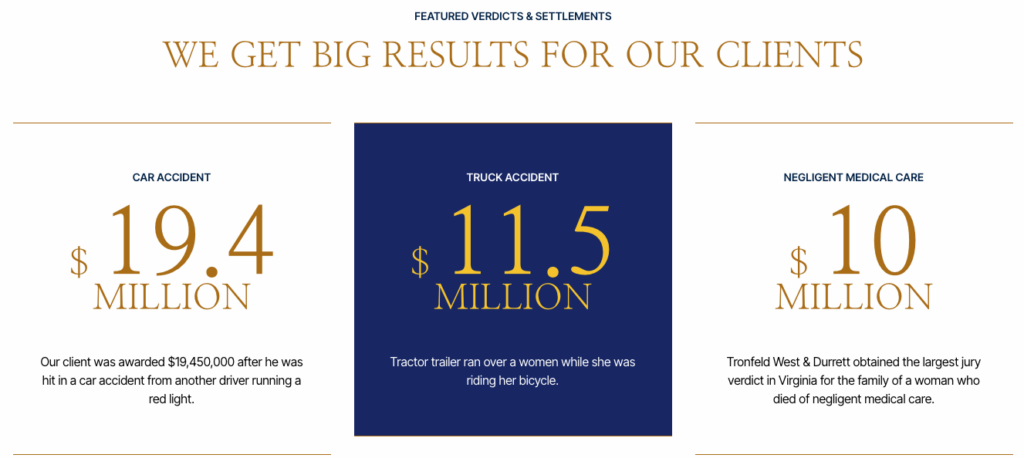
Proving that a defendant failed to maintain a lawful following distance often requires accident reconstruction and a deep understanding of Virginia traffic statutes. Since 1972, Tronfeld West & Durrett has represented thousands of Virginians injured by negligent drivers. We understand how to utilize skid mark analysis, dashcam footage, and witness testimony to prove the other driver violated the safe distance law.
If you or a loved one has been injured due to a driver following too closely, contact Tronfeld West & Durrett today. We offer a Free Consultation and get paid only if we win.
Call or text 800-321-6741 or complete a Free Case Evaluation form