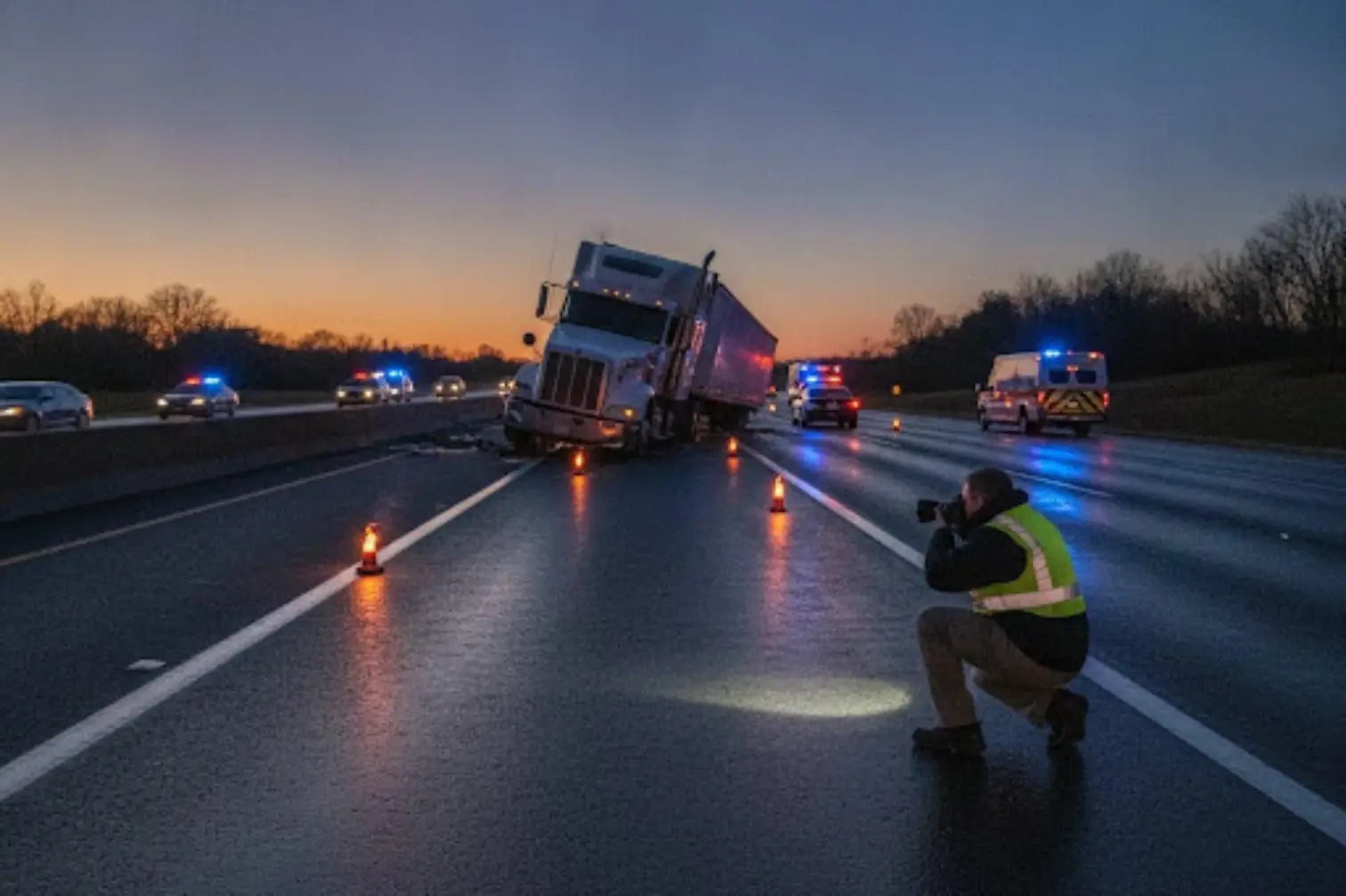

When a tractor-trailer hits your vehicle, the cause is rarely just one driver’s split-second mistake, it is often a chain of safety rules that someone in the trucking operation chose to break. Federal Motor Carrier Safety Administration (FMCSA) regulations set firm limits on how long a driver can stay behind the wheel, how a truck must be maintained, and who is even allowed to operate it, and a violation of those rules can become powerful proof of fault.
This post walks through how those violations support a Virginia injury claim and who can be held responsible. A Virginia truck accident lawyer at Tronfeld West & Durrett can pull the records that reveal these violations and use them to build your case, and there is no fee unless we win.
What FMCSA Regulations Require of Trucking Companies
The FMCSA writes and enforces the federal rules that govern commercial trucking, and those rules exist because a loaded tractor-trailer can weigh 20 to 30 times more than a passenger car. The agency’s Hours of Service regulations cap most property-carrying drivers at 11 driving hours within a 14-hour window and require a 30-minute break after 8 cumulative hours of driving, limits designed to keep fatigued drivers off the road. Other core requirements include:
- Electronic logging devices (ELDs). Most carriers must record driving time electronically so hours cannot be falsified in a paper logbook.
- Driver qualification files. Carriers must verify a commercial license, medical certification, and driving history before putting someone behind the wheel.
- Vehicle maintenance and inspection. Brakes, tires, lighting, and coupling systems must be inspected and repaired on a set schedule.
- Drug and alcohol testing. Drivers are subject to pre-employment, random, and post-crash testing.
When any of these duties is ignored, the failure often shows up in the documents a carrier is required to keep. Virginia also layers its own commercial vehicle rules on top of the federal framework, adding state requirements a carrier must meet alongside the federal ones.
For answers to your questions, call: 800-321-6741
How an FMCSA Violation Supports Negligence in a Virginia Claim
Proving an ordinary car accident usually means showing the other driver failed to act with reasonable care. A trucking case can be stronger because the federal rules already define what that care looks like, so an FMCSA violation can hand you concrete proof of fault in a few ways:
- It sets a clear standard of care. When a carrier or driver violates an FMCSA safety regulation, that breach can support a claim of negligence in a truck accident, because the rule already defines what safe conduct required.
- It can establish negligence per se. In some situations, breaking a safety law written to protect the public is itself evidence of fault, rather than just one factor a jury weighs.
- It turns argument into documentation. A driver who logged 16 hours when federal Hours of Service rules allowed 11 was not simply tired; the records show a direct breach of a binding standard.
That distinction matters in Virginia, which follows a pure contributory negligence rule: if the defense can pin even one percent of the fault on you, your recovery can be barred entirely. Hard documentary proof of an FMCSA breach keeps the focus where it belongs, on the trucking company’s conduct, and it is one of the first things our team works to establish.
Holding the Motor Carrier Responsible
The driver is rarely the only party that matters. Under the doctrine of vicarious liability, a motor carrier is generally responsible for the negligent acts its drivers commit within the scope of their employment. That means the company that dispatched the truck, set the delivery schedule, and maintained the rig can be named directly in your claim.
Carriers can also bear independent fault for their own choices: pressuring drivers to beat deadlines that only fatigue or speeding could meet, skipping required maintenance, or hiring a driver whose record should have disqualified him. Because commercial trucking insurance policies are far larger than typical auto policies, identifying every responsible party often makes the difference in what an injured person can actually recover. A suit against a Virginia carrier is generally filed in the local circuit court, such as the Norfolk Circuit Court for crashes in that area.
Click to contact us today
Freight Broker Liability in a Virginia Truck Accident
Many shipments are arranged not by the carrier but by a freight broker, the middleman that connects a company needing goods moved with a trucking company willing to haul them. For years, brokers argued they could not be sued for crashes because the Federal Aviation Administration Authorization Act (FAAAA) preempted state negligence claims against them. That defense has now narrowed sharply.
In Montgomery v. Caribe Transport II, LLC, decided May 14, 2026, the United States Supreme Court ruled unanimously that the FAAAA’s safety exception saves a negligent-hiring claim against a freight broker from preemption. The Court held that a claim accusing a broker of negligently selecting an unsafe motor carrier falls within the statute’s exception for state laws regulating safety, and it sent the case back for further proceedings.
So can I sue a freight broker after a truck accident in Virginia? After Montgomery, the path is far clearer than it was. Freight broker liability now turns on negligent selection: whether the broker chose a carrier it knew or should have known was unsafe, for example one with a poor safety rating or a history of violations. Tronfeld West & Durrett investigates the full chain, from the driver to the carrier to the broker, so no responsible party is left out.
Complete a Free Case Evaluation form now
What Cases Like Yours Have Recovered
Truck crashes produce some of the most severe injuries we see, and the recoveries reflect that severity.
Our team secured a $4,250,000 settlement for a client who suffered catastrophic injuries following a tractor-trailer accident. In another matter, we recovered an $11,500,000 settlement after a tractor-trailer ran over a bicyclist. These outcomes reflect the kind of full investigation that commercial trucking cases demand, the same approach Tronfeld West & Durrett brings to every claim.
Contact a Virginia Truck Accident Lawyer
Trucking companies and freight brokers have teams working to limit what they pay, often within hours of a crash. You deserve someone working just as hard for you. Tronfeld West & Durrett has spent over 50 years representing injured Virginians, and we are big enough to handle any case while staying small enough to give yours a personal feel. We offer a free consultation, and there is no fee unless we win your case.
To get started, contact Tronfeld West & Durrett for a free, no-obligation review of your claim. We will pull the records, identify every responsible party, and tell you honestly where your case stands.
FAQs About FMCSA Violations Truck Accident Virginia Claims
How do FMCSA violations affect a truck accident claim in Virginia?
A documented FMCSA violation, such as exceeding Hours of Service limits or skipping required maintenance, can serve as direct evidence that the driver or carrier breached a safety duty. That proof helps establish fault and can support a negligence per se argument, which is especially valuable under Virginia’s strict contributory negligence rule.
Can I sue a freight broker after a truck accident in Virginia?
Often, yes. After the Supreme Court’s 2026 decision in Montgomery v. Caribe Transport, a negligent-selection claim against a freight broker is no longer automatically preempted. If a broker hired a carrier it knew or should have known was unsafe, the broker can potentially be held liable.
How long do I have to file a truck accident claim in Virginia?
Virginia generally gives you two years from the date of the crash to file a personal injury lawsuit, under Va. Code § 8.01-243. Waiting risks losing evidence like ELD data and logs, so it is wise to act quickly.
What evidence proves an FMCSA violation?
Driver logs, ELD records, driver qualification files, maintenance and inspection reports, drug and alcohol test results, and the carrier’s safety rating all help. Much of this evidence is in the trucking company’s hands, which is why prompt legal action to preserve it matters.
Call or text 800-321-6741 or complete a Free Case Evaluation form