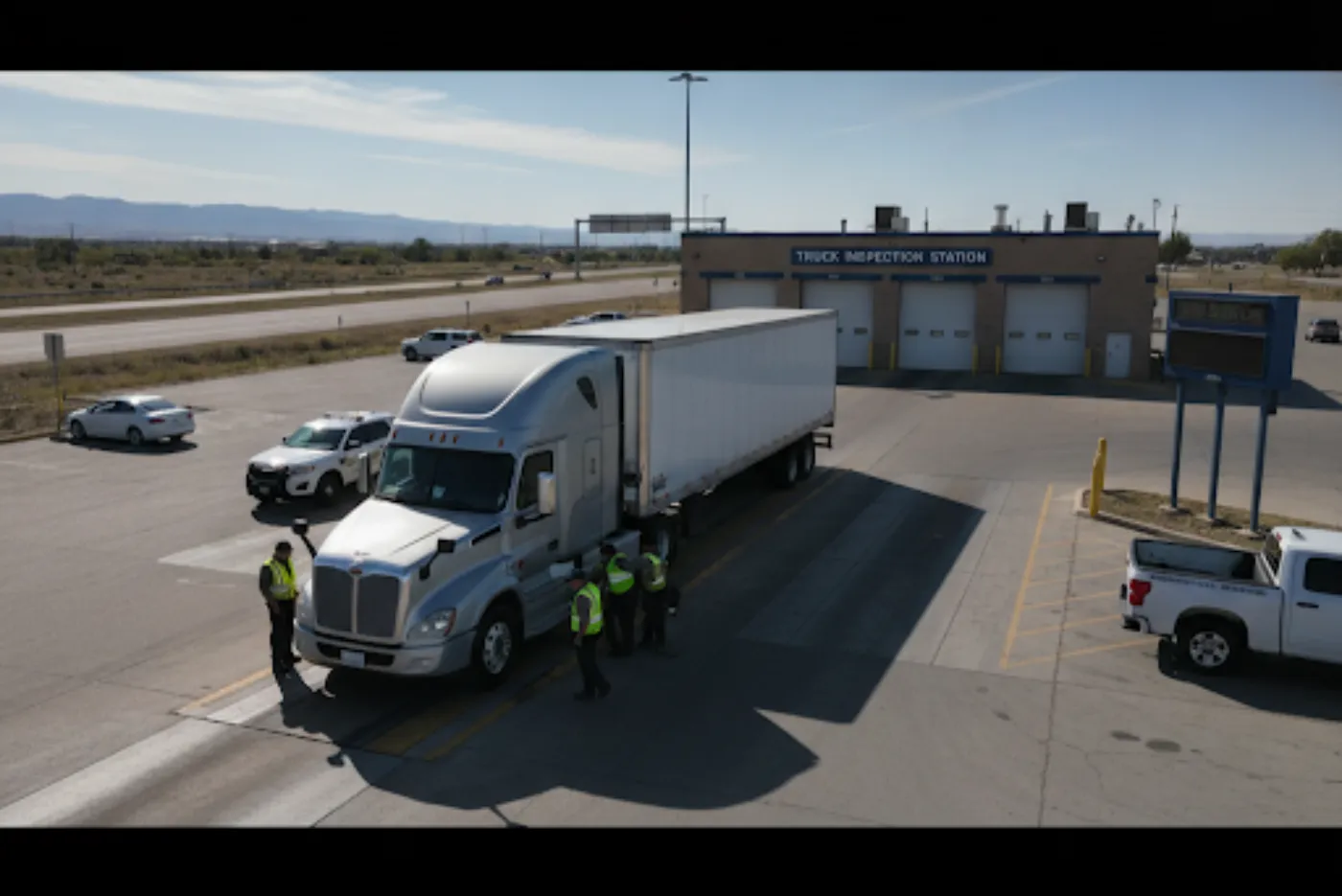

A collision with a tractor-trailer is not a bigger version of a car accident. It is a different kind of case, governed by federal regulations that do not apply to ordinary drivers, built on evidence held by the company you are making a claim against, and often involving several potentially responsible parties rather than one. Those differences change what has to happen in the first weeks. Our commercial truck accident attorneys at Tronfeld West & Durrett handle these claims throughout Virginia.
The Weight Difference Is Also a Legal Difference
Under Va. Code § 46.2-1127, a vehicle traveling a Virginia interstate may carry a gross weight of up to 80,000 pounds, with a single axle up to 20,000 pounds and a tandem axle up to 34,000 pounds. A loaded passenger car is a small fraction of that.
The consequence is not only that injuries are worse. It is that the physics of the collision are outside what passenger vehicle safety systems were engineered to manage. Crumple zones, airbags, and restraint systems are validated against impacts with vehicles of comparable mass. That mismatch is why a truck collision so often produces a catastrophic injury instead of a recoverable one, and why truck crashes are so much more dangerous than their frequency alone would suggest.
For answers to your questions, call: 800-321-6741
Trucking Is a Regulated Industry. Driving a Car Is Not.
An ordinary driver is bound by traffic law. A commercial driver and the carrier employing them are bound by an entire federal regulatory scheme, and every requirement in it is a potential source of liability.
Hours-of-service rules are the clearest example. Under 49 CFR § 395.3, a property-carrying driver must take 10 consecutive hours off duty before driving, may not drive after a 14-consecutive-hour on-duty window has elapsed, may drive no more than 11 hours inside that window, and must interrupt driving for at least 30 consecutive minutes once 8 hours of driving time have passed. Weekly limits cap a driver at 60 hours in 7 days, or 70 hours in 8 days for carriers operating every day.
None of that applies to the driver who rear-ends you on the way home from work. When a trucking company violates it, the violation supplies something a typical car accident claim never has: a documented, federally defined standard the defendant failed to meet. The broader framework of Virginia trucking laws adds state requirements on top.
The Evidence Belongs to the Other Side, and It Expires
This is the difference that costs people the most, because it operates on a clock most claimants never hear about.
In a car accident, the proof is largely neutral: a police report, photographs, medical records. In a truck case, the decisive material sits inside the defendant’s own systems. Electronic logging device data, driver qualification files, maintenance and inspection records, dispatch communications, bills of lading, and post-accident drug and alcohol testing are all held by the carrier.
Federal rules do not require them to keep it indefinitely. 49 CFR § 395.8(k) obligates a carrier to retain records of duty status and supporting documents for not less than six months from the date of receipt. After that window, routine destruction is lawful. A spoliation letter, sent early, puts the carrier on notice that this material must be preserved and creates consequences if it disappears anyway. Sending one is among the first things a truck accident lawyer should do, and it is the step most often missed when a claim is handled without counsel.
Click to contact us today
More Than One Party May Be Responsible
Car accident claims usually involve one at-fault driver and one policy. Truck claims typically involve a chain:
- The driver, for fatigue, distraction, impairment, or aggressive operation.
- The motor carrier, through vicarious liability for an employee acting within the scope of employment, and directly for negligent hiring, inadequate training, poor supervision, or pressuring a driver past lawful hours.
- The maintenance provider, where brake, tire, or coupling failure contributed.
- The shipper or loading company, where cargo was improperly secured, overloaded, or unbalanced.
- A parts manufacturer, where a defective component failed.
Vicarious liability matters practically as well as legally. It brings a corporate defendant with substantially deeper coverage into a case that would otherwise be limited by an individual driver’s policy. Sorting out liability and fault in Virginia truck accidents is usually the first analytical step in the case.
Complete a Free Case Evaluation form now
The Insurance Is Structured Differently
Commercial motor carriers carry federally mandated minimum coverage far above what Virginia requires of a private driver, and larger operations layer excess and umbrella policies above that. This is generally good news for an injured claimant, but it also explains the resistance you will encounter.
A carrier facing seven-figure exposure sends investigators to the scene immediately, sometimes the same day. By the time an injured person is discharged, the other side may already have photographed the scene, downloaded the vehicle data, and taken driver statements. That asymmetry, more than any legal doctrine, is the reason these claims reward early action. It also matters that Virginia is a fault-based state, so recovery depends on proving the carrier’s responsibility rather than filing against your own policy.
What Truck Claims Have Recovered
Hours-of-service violations can transform a case. This firm recovered a $6.5 million settlement, the fourth largest in Virginia that year, for a driver rear-ended on Interstate 95 by a commercial trucker who had been on duty for 37 hours. Our client had just merged back into the right lane after changing a flat tire, was first treated at Southside Regional Medical Center, and was airlifted to VCU Medical Center with life-threatening injuries. Additional outcomes are on our case results page.
Talk to a Virginia Truck Accident Lawyer
The gap between a truck claim and a car claim is widest in the first month, while records still exist and the scene can still be examined. That is also when injured people are least able to attend to it.
Contact Tronfeld West & Durrett for a free consultation with a truck accident lawyer. We have represented injured Virginians since 1972, and there is no fee unless we win your case.
FAQs About Truck Accident Claims in Virginia
Why is insurance on commercial trucks so much higher?
Because the potential harm is so much greater. Federal law sets minimum liability coverage for interstate motor carriers well above ordinary private auto minimums, scaled to the vehicle and the cargo, and many carriers add excess layers. Higher limits mean a serious claim is less likely to exceed the available coverage.
What should I avoid saying to the trucking company’s insurer?
Avoid guessing. Estimates of speed or distance, apologies, and casual statements that you feel fine all get recorded and reused. You are not obligated to give the other side a recorded statement, and in a case where the carrier already has investigators working, declining until you have counsel is reasonable.
Do I sue the driver or the company?
Often both, and sometimes others. The driver’s negligence is usually the starting point, and the carrier’s responsibility attaches through the employment relationship and through its own conduct in hiring, training, supervising, and scheduling.
How quickly does truck accident evidence disappear?
Faster than most people expect. Duty status records need only be kept six months, electronic data can be overwritten, and vehicles are repaired or sold. Preservation demands should go out within days, not months, which is part of how FMCSA violations strengthen a truck accident claim once the records are secured.
Is a truck accident claim worth more than a car accident claim?
Not automatically, but often. Injuries tend to be more severe, more parties may be liable, and available coverage is usually far higher. Severity and coverage, not the size of the vehicle by itself, drive value.
Call or text 800-321-6741 or complete a Free Case Evaluation form